
A New Soap Recipe: Back to the Fat
- vivirae

- Jun 1
- 4 min read
Updated: Jun 2

A few years ago, I shared my first batch of homemade soap here, a recipe from friends using cocoa butter, olive oil, and coconut oil. I've made it many times since, and it's a beautiful soap.
This time, I went in a different direction. I've been more and more drawn toward older ways: the kitchen as apothecary, the pantry as medicine cabinet, the wisdom in fats that our great-grandmothers rendered without thinking twice. So this batch is built on beef tallow and pastured lard, with just a touch of coconut oil for lather and castor oil to help it all bind. A little bentonite clay for that silky skin feel, dried calendula petals mixed in, and essential oils of lavender, vetiver, and rose again, because some things don't need changing.
The result is a harder bar, long-lasting, with a creamy stable lather and a conditioning quality that plant-oil soaps don't quite match. Tallow and lard are extraordinarily close to our skin's own lipid profile, which is part of why they've been used for centuries.
And yes, lye is ancestral too. Long before anyone was buying sodium hydroxide in a bottle, people were making lye water by filtering rainwater through wood ash. The chemistry is similar. Soap has always required something caustic to transform fat into lather. That's what makes it soap.
The Recipe (Makes approximately 56 oz)
Grass-fed beef tallow: 28.8 oz
Pastured lard: 16 oz
Organic cold-pressed virgin coconut oil: 8.4 oz
Organic hexane-free castor oil: 2.8 oz
Water: 18.48 oz
Lye (NaOH): 7.60 oz
Bentonite clay: 3.5 tsp (mixed into oils before combining)
Organic Essential oils: approximately 0.75 oz. I used lavender, vetiver, and rose absolute. It's plenty.
Dried calendula petals
What You'll Need

A kitchen scale, a stainless steel pot, a heat-proof pitcher or glass measuring cup for the lye water, an immersion blender, a large stainless steel spoon, a kitchen thermometer, safety goggles/glasses and
gloves, a wooden soap mold, (or a parchment-lined cardboard box works beautifully).
The Process
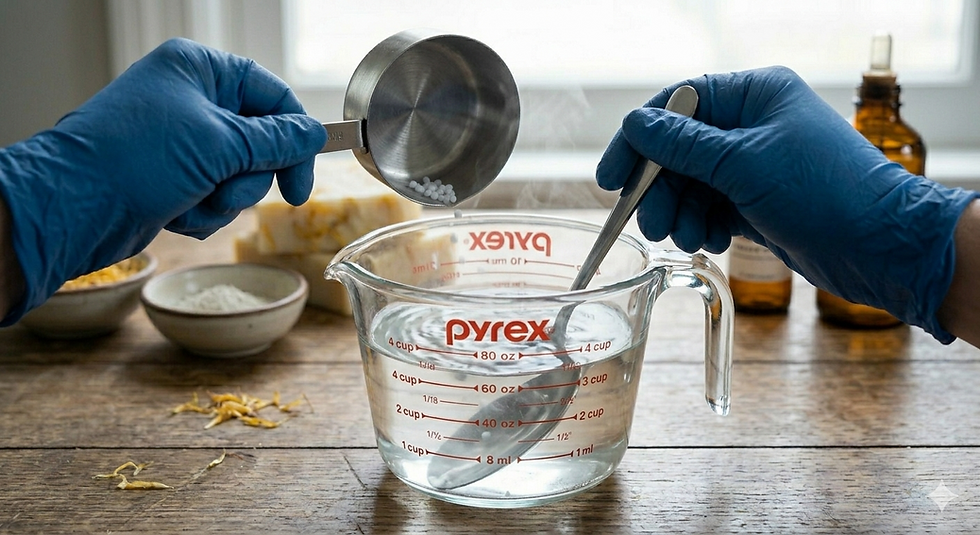
Weigh your fats and melt them together gently in your pot over low heat. Once just melted, remove from heat and let cool. You're aiming for around 110–115°F.
Gear up. Goggles and gloves on before you touch the lye, no exceptions. Work near an open window or outside.
Weigh your water into your heat-proof pitcher. In a separate dry glass container, weigh your lye. Then slowly pour the lye into the water (never the other way around) and stir. It will heat up fast and release fumes, so don't lean over it. Set it somewhere safe to cool to a similar temperature as your oils, around 110–120°F. Lye water can be slightly warmer than the oils but shouldn't be much cooler.
While your oils are still warm, stir the bentonite clay into them until smooth; doing it here rather than in the water prevents clumping.
When both the oils and lye water are within range of each other in temperature, pour the lye water slowly into the oils. Use your immersion blender, keeping it submerged to avoid splashing. Alternate short pulses with hand stirring. Tallow and lard trace faster than plant-oil recipes; you may reach trace within minutes, so don't walk away. You're looking for a light trace, the consistency of warm custard where a drizzle from the blender leaves a faint trail on the surface before sinking.

At trace, stir in your essential oils. Fold in your calendula petals. Pour into your prepared mold.
Leave uncovered at room temperature if warm out. If cold, put a towel over it. The mold can usually provide enough insulation on its own, and tallow soap gels readily without extra help.
Cleanup
Your soap batter and anything it touched (pot, blender, spatula) remains caustic until saponification is complete, roughly 24 hours. Keep your gloves on while washing everything thoroughly with hot water and plenty of soap. Stainless steel, glass, and silicone clean up completely fine for future food use. Avoid wooden utensils for soap making, as wood is porous and harder to fully clean.
A Note on Cutting
Tallow bars harden fast. Check yours at 6–12 hours after pouring; it should have the give of firm cheese. Miss that window and leave it alone until the 24–36 hour mark. After that it may be too brittle to cut cleanly without warming it first.
Cure for 6–8 weeks. Worth every day of waiting.
On Quality and Why it Matters
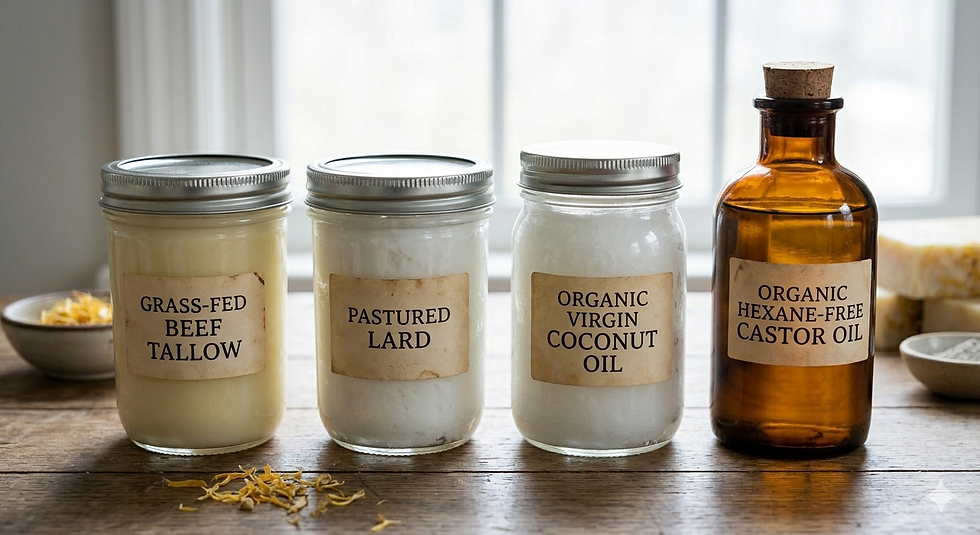
Coconut oil that's cold-pressed and virgin retains its natural antioxidants and hasn't been exposed to the high heat or chemical solvents used in refined processing, both of which degrade the oil before it ever reaches your skin. The same logic applies to castor oil: hexane is a petroleum-derived solvent commonly used to extract oils from seeds, and while most of it evaporates, residues can remain. Hexane-free means the oil was pressed mechanically, nothing else. Glass bottles matter too; oils sitting in plastic absorb phthalates and other endocrine-disrupting compounds over time, especially in heat.
Pastured lard and grass-fed tallow aren't just an ethical choice; the fat profile is genuinely different. Animals raised on pasture and grass produce fat with higher levels of fat-soluble vitamins A, D, E, and K, as well as a better omega-3 to omega-6 ratio. These qualities carry into the soap and into your skin. Rendered fat from a feedlot animal, fed grain and raised in confinement, simply isn't the same thing.

What goes on your skin is as worth tending as what goes in your body. Skin is a living organ, not a barrier. It absorbs, which is exactly why soap made with integrity matters.
A Note on Substitutions
If you swap any oils or fats, run your recipe through a lye calculator before mixing as the lye amount is specific to your fat blend. SoapCalc is a reliable free option.
If you'd rather skip the soap-making and let me do it for you, you're welcome to purchase a bar here.


Comments